In Colombia's coffee-growing hills, sustainability starts close to home
For six years, Reinaldo Holguín made the same journey: carrying harvested coffee from his farm in the rural village of El Bujío uphill to his father's property, around 15 minutes away, to use a shared drying facility. During harvest season, space was tight and the process crowded. Like so many smallholder farmers in the mountains of Antioquia, he worked with what he had.
"Before this project provided supplies, coffee seedlings, and now drying greenhouses, we simply did not have them," he says.
Reinaldo lives with his wife and young daughter on a small farm where coffee is both livelihood and identity. It is a crop that has long shaped the culture and economy of the region. But for families like his, keeping a productive farm running means navigating rising costs, limited infrastructure, and the persistent sense of being overlooked.
When he arrived in San Andrés six years ago, the signs of that neglect were visible. An industry that had once defined the area had been allowed to decline.
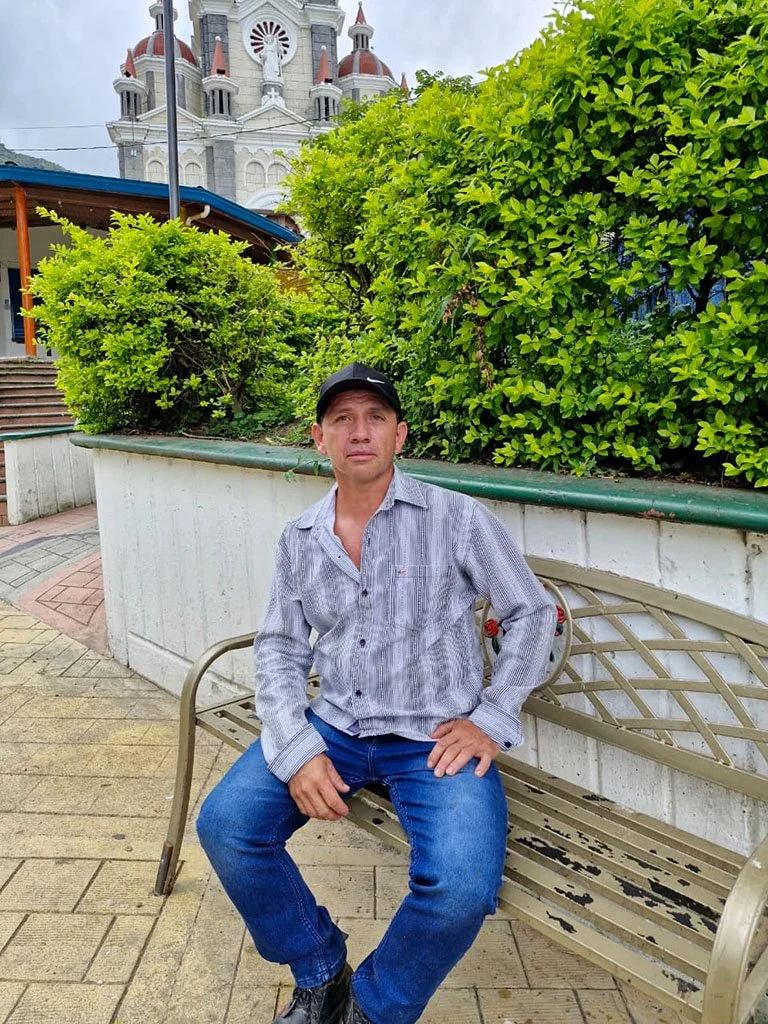
Reinaldo Holguín is a local coffee farmer in El Bujío and president of the community's Community Action Board.
The constraints are more specific than they might appear from the outside. A single bag of fertiliser costs around 190,000 Colombian pesos – roughly 50 US dollars – enough that farmers sometimes have no choice but to leave trees unfertilised and watch yields suffer. Infrastructure presents its own barriers, and building a drying greenhouse has simply been beyond the financial reach of most families.
"Sometimes we are people who feel forgotten," he says. "We always want to have good harvests, but without support, it becomes very difficult."
That support has begun to arrive. Reinaldo is now among around 140 coffee-growing families benefiting from a partnership between the Municipality of San Andrés de Cuerquia, Colombia's coffee-growers federation, and Generadora Chorreritas, the company behind the Chorreritas hydropower project. Through the initiative, farmers have received nursery development, agricultural training, productivity support and post-harvest infrastructure. For Reinaldo, the most tangible change has been the prospect of his own drying greenhouse.
The difference matters more than it might sound. Traditionally, many growers dry coffee on open patios or tarpaulins, scrambling to move it under cover when rain arrives and back out again when it clears. This is a labour-intensive process that takes a toll on quality. Reinaldo has seen the consequences firsthand.
"I had the experience of selling coffee at the cooperative, and they immediately notice the difference," he says. "When coffee is dried in open patios instead of inside drying greenhouses, it absorbs bad odours, and they end up paying a lower price for it."
Reinaldo speaks not only as a farmer, but as president of the Community Action Board of El Bujío. This is a role that gives him a clear view of how the programme is rippling through the wider community.
"Receiving a drying greenhouse, or two bags of fertiliser, may not seem like much to others," he says, "but for us it is huge."
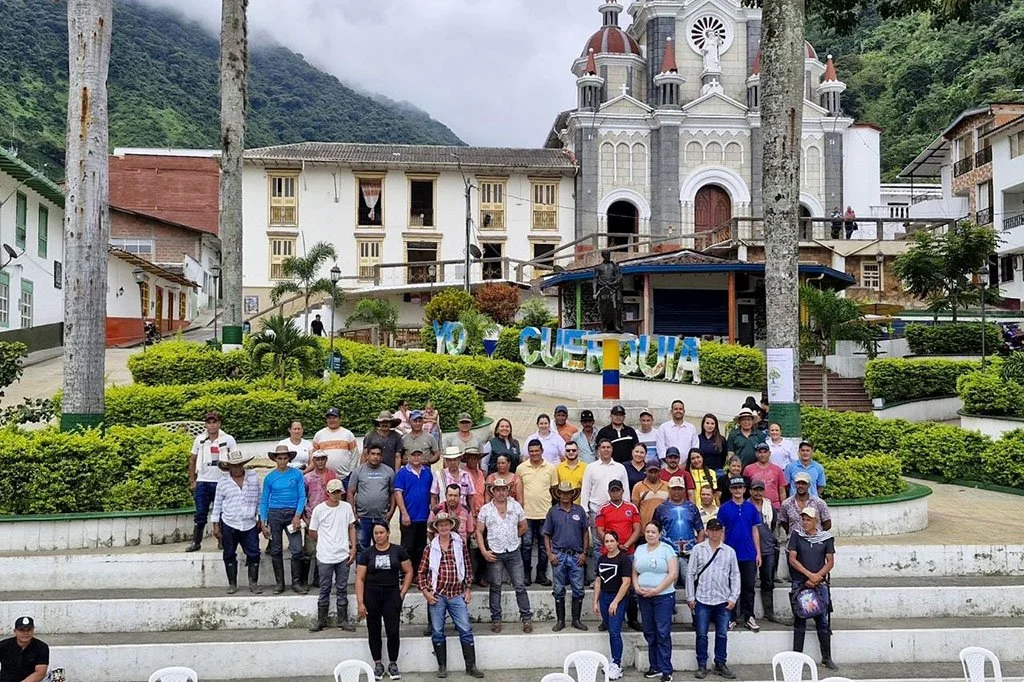
The Chorreritas programme supports coffee-growing families in San Andrés de Cuerquia through nursery development, agricultural training and post-harvest infrastructure.
Built into the territory: investing beyond the dam
Hydropower projects are too often measured solely by the electricity they generate. But for the communities that live alongside them, the relationship with that infrastructure is woven into daily life.
Those realities have helped shape a broader approach to sustainability around the Chorreritas project. Recognising those connections, Energo-Pro Colombia, the parent company of Generadora Chorreritas, has worked with local communities and institutions on initiatives that extend beyond the project's energy generation role.
"Projects like Chorreritas are deeply embedded in a territory's social, environmental and economic context," says Alexandra Rey, ESG Manager at Energo-Pro Colombia. "We wanted Chorreritas to generate shared value, not only clean energy, but also stronger local capacities, environmental stewardship, and sustainable economic opportunities that contribute to the long-term prosperity and resilience of families and communities in the region."
The coffee partnership grew directly from listening and understanding local experience. Rather than importing new economic ideas, the programme focused on strengthening what communities already knew and depended on.

Alexandra Rey is ESG Manager at Energo-Pro Colombia.
"Coffee production is deeply connected to the identity, culture and economy of the region," says Alexandra. "When we engaged with local communities, it became clear that supporting coffee-growing families could have a direct and meaningful impact on livelihoods while also strengthening the local economy in a sustainable way."
The coffee initiative sits within a wider effort that spans community governance, education, local business development, environmental protection, health campaigns, and investment in community infrastructure. Local organisations have been supported to strengthen their governance and access public funding. Small businesses have received training and mentoring to improve their competitiveness and deepen their role in local supply chains.
Underpinning all of it, Alexandra says, is a willingness to understand what makes infrastructure projects succeed or fail over time. "Projects become more resilient and sustainable when communities feel they are active participants in the process rather than simply observers."
Taken together, these programmes reflect a view of sustainability as an ongoing relationship that evolves with the territory and the people who live in it.
Sustainability as a continuous process
This commitment has been tested and recognised externally. The Chorreritas project achieved Silver certification under the Hydropower Sustainability Standard during construction after an independent assessment of its environmental, social and governance performance. For the team at Energo-Pro, the process has been just as valuable as the outcome.
"The certification process was extremely valuable because it challenged us to look at sustainability in a more integrated and rigorous way," says Alexandra. "It reinforced the idea that sustainability is not only about environmental compliance, but also about governance, transparency, stakeholder engagement, and long-term social impact."
In 2025, that work received further recognition when Generadora Chorreritas was awarded an AA category distinction under the Sustainability Seal from Corantioquia, the regional environmental authority. This is a recognition that spans climate change management, social performance, governance, innovation and sustainability practice.
"Receiving the AA Sustainability Seal from Corantioquia was very meaningful for our team, because it validated years of effort and commitment to responsible environmental management and community engagement," says Alexandra. "More importantly, the recognition reflects the collective work carried out with local communities, institutions and partners around Chorreritas."
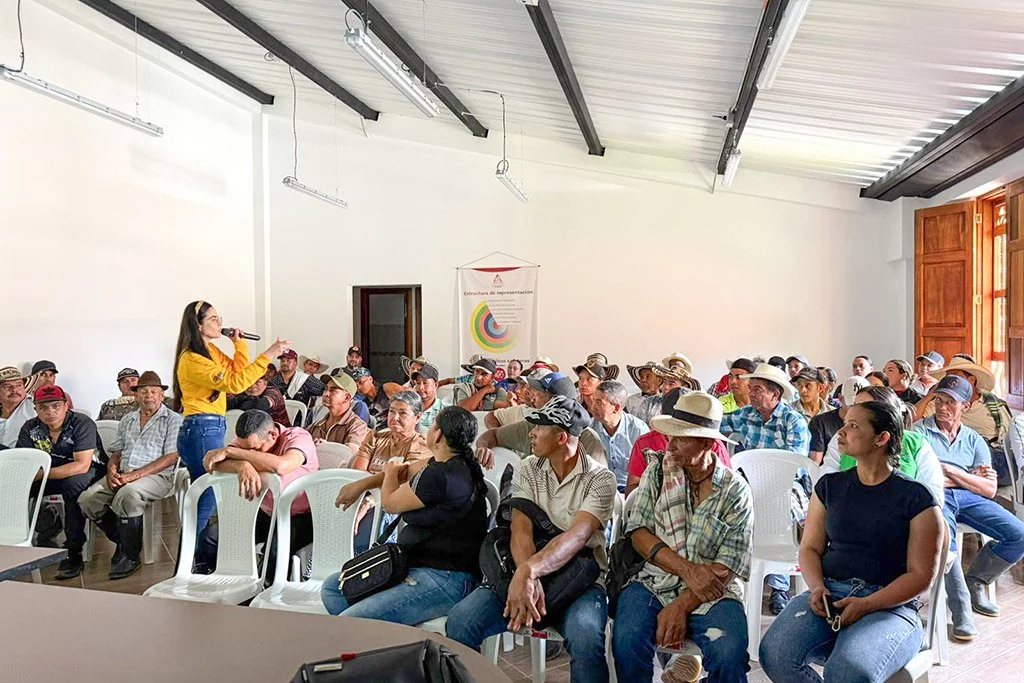
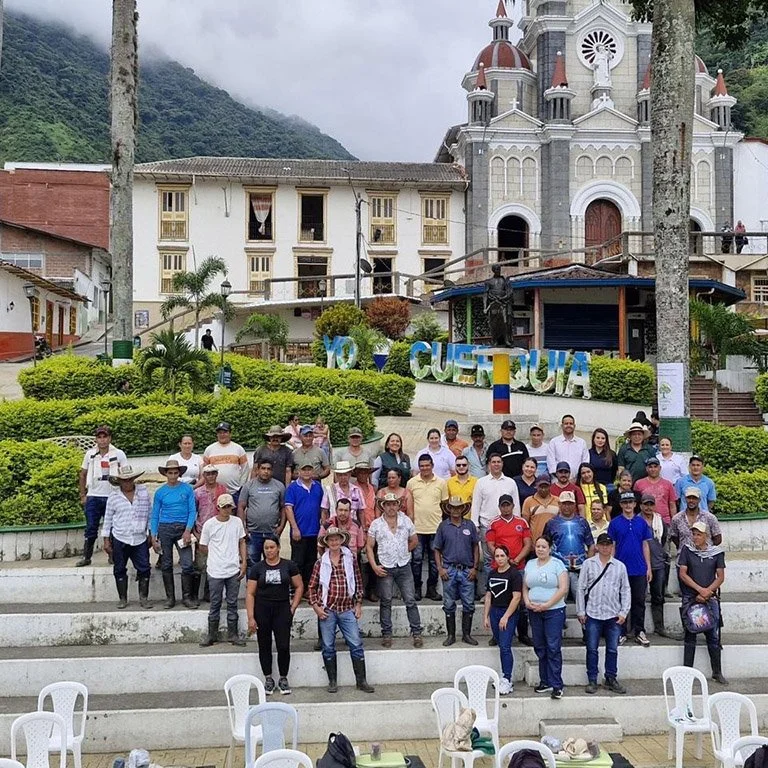
Participants gather for a training session as part of the Chorreritas programme supporting around 140 coffee-growing families in San Andrés de Cuerquia.
"We want to see San Andrés return to what it once was"
Back in El Bujío, conversations about sustainability are closer to home. For Reinaldo and his family, it means access to fertiliser when budgets are stretched, better coffee quality, and less time spent hauling harvests between properties. It means environmental training that is already changing how people manage the land around them in the San Andrés Valley. And it means something harder to quantify: a sense that decline is not inevitable, and that the industry can be rebuilt.
"It is very important that these communities continue to receive attention and support whenever possible," he says. "We want to see San Andrés return to what it once was, when coffee production was thriving. It has declined, but with this kind of support, I believe it will continue growing again."
His hopes are similar to so many of those in the local community: stronger harvests, continued investment, and the chance for families to stay and build their lives in the places they call home.
For hydropower developers working in communities around the world, the experience at Chorreritas is a reminder that sustainability is often shaped by an understanding of local priorities. In the San Andrés Valley, that has meant investing in coffee-growing families and working alongside local institutions to strengthen an industry that has long been central to the region's identity and economy.
In El Bujío, those ambitions may begin with something as simple as a drying greenhouse beside a family home.
AUTHOR

MORE BLOGS